In-Silico Evaluation of Phenylisocytosine and Its Analogs as Potent Inhibitors of Plasmodium Falciparum Transketolase: A Strategic Approach in Anti-Malarial Drug Discovery
Opeyemi Emmanuel Atanda
Department of Biochemistry, Ladoke Akintola University of Technology, Ogbomosho, Oyo State, Nigeria.
Lamidi Waheed Babatunde Olaniyan
Department of Biochemistry, Ladoke Akintola University of Technology, Ogbomosho, Oyo State, Nigeria.
Olatomide Ayodeji Fadare
Department of Chemistry, Obafemi Awolowo University, Ile-Ife, Osun State, Nigeria.
Adeola Folasade Ehigie
Department of Biochemistry, Ladoke Akintola University of Technology, Ogbomosho, Oyo State, Nigeria.
Tawakalit Abimbola Adisa
Department of Biochemistry, Ladoke Akintola University of Technology, Ogbomosho, Oyo State, Nigeria.
Temitope Tunji Odunitan
Department of Biochemistry, Ladoke Akintola University of Technology, Ogbomosho, Oyo State, Nigeria.
Oluwabunmi Temitope Alabi
Department of Biochemistry, Ladoke Akintola University of Technology, Ogbomosho, Oyo State, Nigeria.
Bukola Adeola Omonijo
Department of Biochemistry, Ladoke Akintola University of Technology, Ogbomosho, Oyo State, Nigeria.
Aloba Gideon Oluwaseun
Department of Biochemistry, Ladoke Akintola University of Technology, Ogbomosho, Oyo State, Nigeria.
Leonard Ona Ehigie *
Department of Biochemistry, Ladoke Akintola University of Technology, Ogbomosho, Oyo State, Nigeria.
*Author to whom correspondence should be addressed.
Abstract
Background: The rise of drug-resistant Plasmodium falciparum strains, particularly those resistant to artemisinin-based combination therapies (ACTs), underscores the urgent need for alternative antimalarial agents targeting novel biochemical pathways.
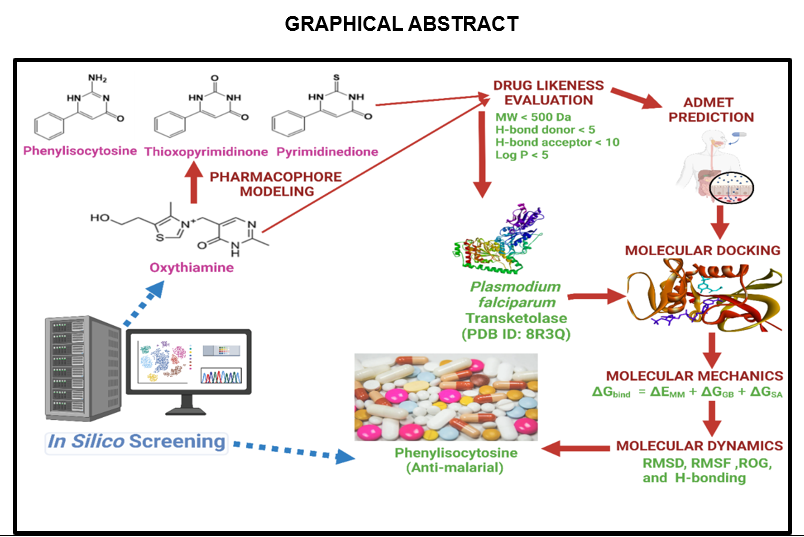
Aim: This study investigates the potential of pyrimidine-based compounds (phenylisocytosine, thioxopyrimidinone, and pyrimidinedione) as potential inhibitors of transketolase, a critical enzyme in the pentose phosphate pathway essential for parasite nucleotide synthesis and redox homeostasis.
Methodology: Selected for their structural similarity to oxythiamine—a potent but nephrotoxic and carcinogenic transketolase inhibitor—these compounds were modified to improve safety profiles while retaining inhibitory efficacy. Using a combination of ligand-based and structure-based drug design approaches, comprehensive in silico assessments were conducted. Pharmacokinetic and toxicological profiling were evaluated using Lipinski’s Rule of Five and ADMET profiling. Binding affinities were determined through molecular docking, while binding free energies were calculated using molecular mechanics. Binding stability was further investigated through molecular dynamics simulations.
Results: Pharmacokinetic evaluations, including drug-likeness and ADMET profiling, indicated favorable drug-like properties and low toxicity across all compounds. Molecular docking studies identified phenylisocytosine as having the highest binding affinity with Plasmodium falciparum transketolase (-6.3 kcal/mol in AutoDock Vina and -8.5 kcal/mol in iGEMDock), outperforming both thioxopyrimidinone and pyrimidinedione. Molecular mechanics calculations confirmed phenylisocytosine’s superior binding free energy (-26.05 kcal/mol), with the reference drug oxythiamine exhibiting the weakest interaction (-16.85 kcal/mol). Molecular dynamics simulations over 50 nanoseconds further validated phenylisocytosine as the most stable ligand in complex with Plasmodium falciparum transketolase, with an RMSD of 0.30 nm, RMSF of 0.12 nm, ROG of 3.01 nm, and H-bond length of 1.01 nm. Although thioxopyrimidinone and oxythiamine showed moderate stability, phenylisocytosine consistently excelled across all parameters.
Conclusion: These findings position phenylisocytosine as a promising candidate for further experimental validation, to evaluate its efficacy, safety, and therapeutic potential as a novel antimalarial drug.
Keywords: Antimalarial resistance, plasmodium falciparum transketolase, oxythiamine, Phenylisocytosine, ligand-based drug design, structure-based drug design