Computational Evaluation of Some Schiff-Bases of Phenylisocytosine as Potent Inhibitors of Plasmodium falciparum Transketolase in Anti-Malarial Drug Discovery
Opeyemi Emmanuel Atanda
Department of Biochemistry, Ladoke Akintola University of Technology, Ogbomosho, Oyo State, Nigeria.
Adeola Folasade Ehigie
Department of Biochemistry, Ladoke Akintola University of Technology, Ogbomosho, Oyo State, Nigeria.
Tawakalit Abimbola Adisa
Department of Biochemistry, Ladoke Akintola University of Technology, Ogbomosho, Oyo State, Nigeria.
Lamidi Waheed Babatunde Olaniyan
Department of Biochemistry, Ladoke Akintola University of Technology, Ogbomosho, Oyo State, Nigeria.
Temitope Tunji Odunitan
Department of Biochemistry, Ladoke Akintola University of Technology, Ogbomosho, Oyo State, Nigeria.
Olatomide Ayodeji Fadare
Department of Chemistry, Obafemi Awolowo University, Ile-Ife, Osun State, Nigeria.
Mary Oyindamola Jesulade
Department of Biochemistry, Ladoke Akintola University of Technology, Ogbomosho, Oyo State, Nigeria.
Adedamola Onikepo Adesina
Department of Biochemistry, Ladoke Akintola University of Technology, Ogbomosho, Oyo State, Nigeria.
Leonard Ona Ehigie *
Department of Biochemistry, Ladoke Akintola University of Technology, Ogbomosho, Oyo State, Nigeria.
*Author to whom correspondence should be addressed.
Abstract
Background: The increasing prevalence of drug-resistant Plasmodium falciparum strains, particularly resistance to frontline therapies such as artemisinin and its derivatives, poses a significant challenge to malaria control and eradication efforts. This necessitates the development of novel antimalarial agents targeting alternative biochemical pathways.
Aim: This study investigated six Schiff bases of phenylisocytosine as potential inhibitors of Plasmodium falciparum transketolase, a key enzyme in the pentose phosphate pathway critical for parasite survival.
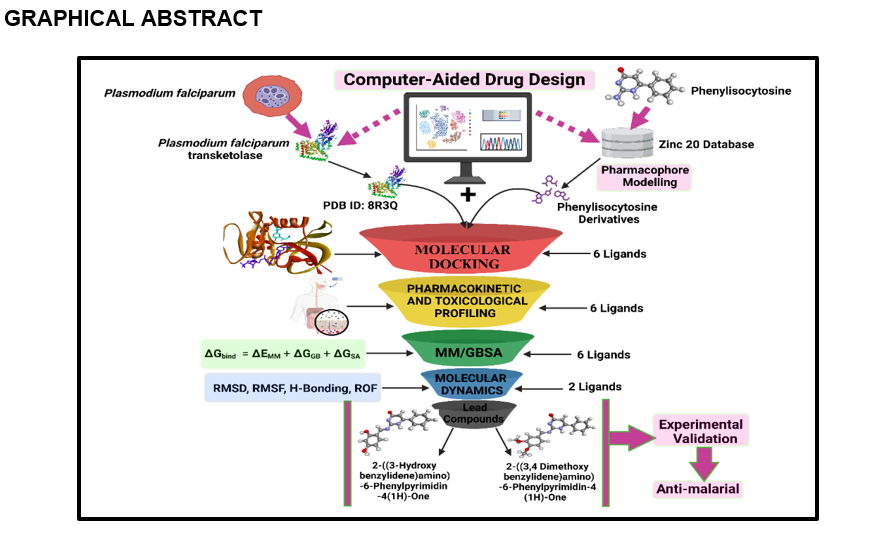
Methodology: An integrated computer-aided drug design comprising ligand-based and structure-based approaches was employed. Molecular docking analyses was conducted using AutoDock Vina and iGEMDock to evaluate binding affinities and interactions. Pharmacokinetic and toxicological profiling were evaluated using Lipinski’s Rule of Five and ADMET prediction via pkCSM and the ADMETLab 3.0 webserver. Molecular mechanics generalized Born surface area (MM/GBSA) calculations was performed using Schrondiger Maestro 12.5 to determine binding free energies. Molecular dynamics (MD) simulations was carried out using GROMACS 2023 to evaluate the stability, flexibility, and compactness of protein-ligand complexes over 50 nanoseconds.
Results: Molecular docking identified (E)-2-((3,4-Dimethoxybenzylidene)amino)-6-Phenylpyrimidin-4(1H)-One and (E)-2-((3-Hydroxybenzylidene)amino)-6-Phenylpyrimidin-4(1H)-One as the top-performing ligands with binding energies of -7.7 and -7.5 kcal/mol (AutoDock Vina) and -10.3 and -9.7 kcal/mol (iGEMDock Vina), respectively, outperforming oxythiamine binding energies of -5.2 kcal/mol (AutoDock Vina) and -7.1 kcal/mol (iGEMDock Vina). Pharmacokinetic evaluations confirmed favorable drug-likeness and low toxicity profiles for the selected Schiff bases. MM/GBSA calculations demonstrated strong binding free energies of -31.21 and -31.01 kcal/mol for these compounds, compared to -16.85 kcal/mol for oxythiamine. MD simulations validated their exceptional stability, with RMSD values of 0.313 and 0.277 nm, RMSF values of 0.142 and 0.130 nm, and compact ROG values of 2.997 and 3.007 nm, respectively. H-bonding analysis revealed consistent and strong interactions, further supporting the stability of these complexes.
Conclusion: The findings establish (E)-2-((3,4-Dimethoxybenzylidene)amino)-6-Phenylpyrimidin-4(1H)-One and (E)-2-((3-Hydroxybenzylidene)amino)-6-Phenylpyrimidin-4(1H)-One as promising candidates for further experimental validation. Their strong binding affinities, stability, and favorable safety profiles underscore their potential as novel antimalarial agents to combat drug-resistant malaria.
Keywords: Anti-malarial resistance, Computer-aided drug design, Plasmodium falciparum transketolase, oxythiamine, phenylisocytosine